ai/qwen3-coder repository overview
See our collection for all versions of Qwen3 including GGUF, 4-bit & 16-bit formats.
Learn to run Qwen3-Coder correctly - Read our Guide.
See Unsloth Dynamic 2.0 GGUFs for our quantization benchmarks.



✨ Read our Qwen3-Coder Guide here!
- Fine-tune Qwen3 (14B) for free using our Google Colab notebook!
- Read our Blog about Qwen3 support: unsloth.ai/blog/qwen3
- View the rest of our notebooks in our docs here. | Unsloth supports | Free Notebooks | Performance | Memory use | |-----------------|--------------------------------------------------------------------------------------------------------------------------|-------------|----------| | Qwen3 (14B) | ▶️ Start on Colab | 3x faster | 70% less | | GRPO with Qwen3 (8B) | ▶️ Start on Colab | 3x faster | 80% less | | Llama-3.2 (3B) | ▶️ Start on Colab | 2.4x faster | 58% less | | Llama-3.2 (11B vision) | ▶️ Start on Colab | 2x faster | 60% less | | Qwen2.5 (7B) | ▶️ Start on Colab | 2x faster | 60% less |
Qwen3-Coder-30B-A3B-Instruct

Highlights
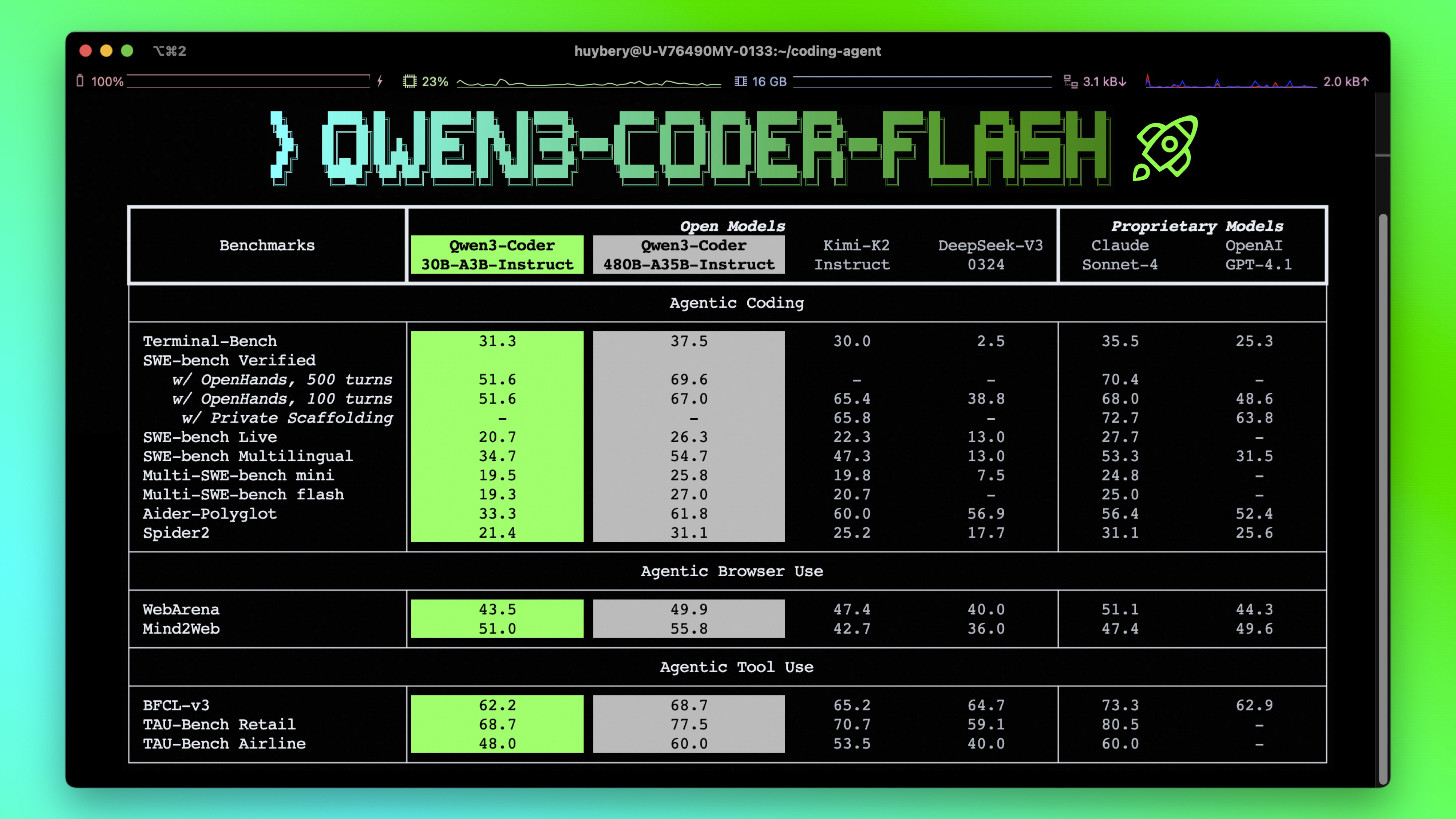
Qwen3-Coder is available in multiple sizes. Today, we're excited to introduce Qwen3-Coder-30B-A3B-Instruct. This streamlined model maintains impressive performance and efficiency, featuring the following key enhancements:
- Significant Performance among open models on Agentic Coding, Agentic Browser-Use, and other foundational coding tasks.
- Long-context Capabilities with native support for 256K tokens, extendable up to 1M tokens using Yarn, optimized for repository-scale understanding.
- Agentic Coding supporting for most platform such as Qwen Code, CLINE, featuring a specially designed function call format.
Model Overview
Qwen3-Coder-30B-A3B-Instruct has the following features:
- Type: Causal Language Models
- Training Stage: Pretraining & Post-training
- Number of Parameters: 30.5B in total and 3.3B activated
- Number of Layers: 48
- Number of Attention Heads (GQA): 32 for Q and 4 for KV
- Number of Experts: 128
- Number of Activated Experts: 8
- Context Length: 262,144 natively.
NOTE: This model supports only non-thinking mode and does not generate <think></think> blocks in its output. Meanwhile, specifying enable_thinking=False is no longer required.
For more details, including benchmark evaluation, hardware requirements, and inference performance, please refer to our blog, GitHub, and Documentation.
Quickstart
We advise you to use the latest version of transformers.
With transformers<4.51.0, you will encounter the following error:
KeyError: 'qwen3_moe'
The following contains a code snippet illustrating how to use the model generate content based on given inputs.
from transformers import AutoModelForCausalLM, AutoTokenizer

model_name = "Qwen/Qwen3-Coder-30B-A3B-Instruct"

# load the tokenizer and the model
tokenizer = AutoTokenizer.from_pretrained(model_name)
model = AutoModelForCausalLM.from_pretrained(
    model_name,
    torch_dtype="auto",
    device_map="auto"
)

# prepare the model input
prompt = "Write a quick sort algorithm."
messages = [
    {"role": "user", "content": prompt}
]
text = tokenizer.apply_chat_template(
    messages,
    tokenize=False,
    add_generation_prompt=True,
)
model_inputs = tokenizer([text], return_tensors="pt").to(model.device)

# conduct text completion
generated_ids = model.generate(
    **model_inputs,
    max_new_tokens=65536
)
output_ids = generated_ids[0][len(model_inputs.input_ids[0]):].tolist()

content = tokenizer.decode(output_ids, skip_special_tokens=True)

print("content:", content)
Note: If you encounter out-of-memory (OOM) issues, consider reducing the context length to a shorter value, such as 32,768.
For local use, applications such as Ollama, LMStudio, MLX-LM, llama.cpp, and KTransformers have also supported Qwen3.
Agentic Coding
Qwen3-Coder excels in tool calling capabilities.
You can simply define or use any tools as following example.
# Your tool implementation
def square_the_number(num: float) -> dict:
    return num ** 2

# Define Tools
tools=[
    {
        "type":"function",
        "function":{
            "name": "square_the_number",
            "description": "output the square of the number.",
            "parameters": {
                "type": "object",
                "required": ["input_num"],
                "properties": {
                    'input_num': {
                        'type': 'number',
                        'description': 'input_num is a number that will be squared'
                        }
                },
            }
        }
    }
]

import OpenAI
# Define LLM
client = OpenAI(
    # Use a custom endpoint compatible with OpenAI API
    base_url='http://localhost:8000/v1',  # api_base
    api_key="EMPTY"
)

messages = [{'role': 'user', 'content': 'square the number 1024'}]

completion = client.chat.completions.create(
    messages=messages,
    model="Qwen3-Coder-30B-A3B-Instruct",
    max_tokens=65536,
    tools=tools,
)

print(completion.choice[0])
Best Practices
To achieve optimal performance, we recommend the following settings:
-
Sampling Parameters:
- We suggest using
temperature=0.7,top_p=0.8,top_k=20,repetition_penalty=1.05.
- We suggest using
-
Adequate Output Length: We recommend using an output length of 65,536 tokens for most queries, which is adequate for instruct models.
Citation
If you find our work helpful, feel free to give us a cite.
@misc{qwen3technicalreport,
      title={Qwen3 Technical Report},
      author={Qwen Team},
      year={2025},
      eprint={2505.09388},
      archivePrefix={arXiv},
      primaryClass={cs.CL},
      url={https://arxiv.org/abs/2505.09388},
}
Tag summary
Content type
Unrecognized
Digest
sha256:69e23c1ba…
Size
17.3 GB
Last updated
about 2 months ago
docker pull ai/qwen3-coderThis week's pulls
Pulls:
4,677
Last week